Camp Power And Solar · Volume 1
Sizing the Camp Power System — Small, Cheap, and Recharged in a Day
Introduction
✅ RESOLVED 2026-08-30 — and this dive turned out to describe the WHOLE electrical system, not half of it. 🔴 There is no separate truck bank. The fridge came out of the build, the DC-DC architecture in Vehicle Power was never built, and this camp station is now the only electrical system the rig has. ✅ Both halves are bought. The camp battery is an EcoFlow River 3 Max Plus, 858 Wh, 24 lb, and the panel is a Renogy 200 W portable, 13.9 lb — matched to the pack’s 220 W solar input at 91 percent of the cap. ⚠ Needs an MC4-to-XT60 adapter. 🔴 The Anker SOLIX F3000 is permanently out of the build, as this dive recommended. ⭐ The panel covers a night of CPAP in 24–60 minutes of good sun. → Weight and Balance vol 3.
This is the other half of the electrical system. Vehicle Power deals with the truck’s own bank and the DC-DC charger; this deals with the standalone battery that runs camp — and the owner’s brief is specific: small, inexpensive, a decent battery and charger, 110 V charging as well as solar, and recharged in a single day of sun.
⭐ That last requirement does more work than it looks like. It is the constraint that sets the panel size, and it rules out the 100 W panel most people would buy.
🔴 And one number dominates everything: the CPAP is 47 percent of the daily load, and it is still an estimate.
1.1 The daily load
Table 1 — The daily load
| Load | Wh/day | Basis |
|---|---|---|
| ✅ CPAP, humidifier + heated tube off | 80–200 | 10–25 W at 8 h — ResMed’s own figure. See below |
| LED camp lights, awning and tent | 40 | ~10 W for 4 hours |
| RO unit, recharging its internal pack | 60 | ~45 Wh pack plus charging losses, one charge a day |
| Shower pump, short-cycle | 10 | ~50 W for about 8 minutes across two showers |
| Phones and misc USB | 25 | |
| Daily total | 215–335 Wh | mid-band ≈ 275 Wh |
Two observations before any hardware:
⭐ The shower pump is a rounding error. Ten watt-hours. The on-off-on discipline the owner described costs essentially nothing and it was never going to — a pump running four minutes a day is not a design problem.
✅ The CPAP figure is now sourced, and it corrects a standing project claim. ResMed give the AirSense 10 at 10–25 W — roughly 1–2 A at 12 V — with the humidifier and heated tube off. 🔴 The project has recorded since the Vehicle Power dive that this figure “is not published.” That was wrong, and the record is corrected here.
⭐ The long-standing 7–14 Ah estimate turns out to have been good. ResMed’s range works out to 6.7–16.7 Ah over an eight-hour night — the estimate was right in the middle and slightly optimistic at the top.
⚠ The band is wide because it is driven by prescribed pressure. Ten watts and twenty-five watts are the same machine at different settings, so where in that band this build actually sits is still a per-machine question — and it is worth knowing, because it is the difference between 2.9 and 1.8 nights of autonomy.
⭐ The gate is no longer “is this 7 Ah or 14 Ah” — it is “which end of ResMed’s own band does my prescription put me at.” That is a much smaller question, and Tasks/CPAP/AS10-BENCH-SHEET.html answers it in one evening. Nothing below is blocked on it any more.
1.2 Battery sizing
Autonomy is the question: how many nights without usable sun?
Table 2 — Autonomy is the question: how many nights without usable sun?
| Nights | At 215 Wh/day | At 275 Wh/day | At 335 Wh/day |
|---|---|---|---|
| 1 | 269 Wh | 344 Wh | 419 Wh |
| 2 | 538 Wh | 688 Wh | 838 Wh |
| 3 | 806 Wh | 1,031 Wh | 1,256 Wh |
(LiFePO4 nominal, 80% usable)
⭐ Two nights is the right target. One night leaves no margin for a cloudy day; three buys capacity for a scenario the truck’s alternator already solves, since two hours of driving recharges everything.
That lands between 540 and 840 Wh depending on where the CPAP sits in its band — which puts the 768 Wh budget class squarely in the middle of the requirement.
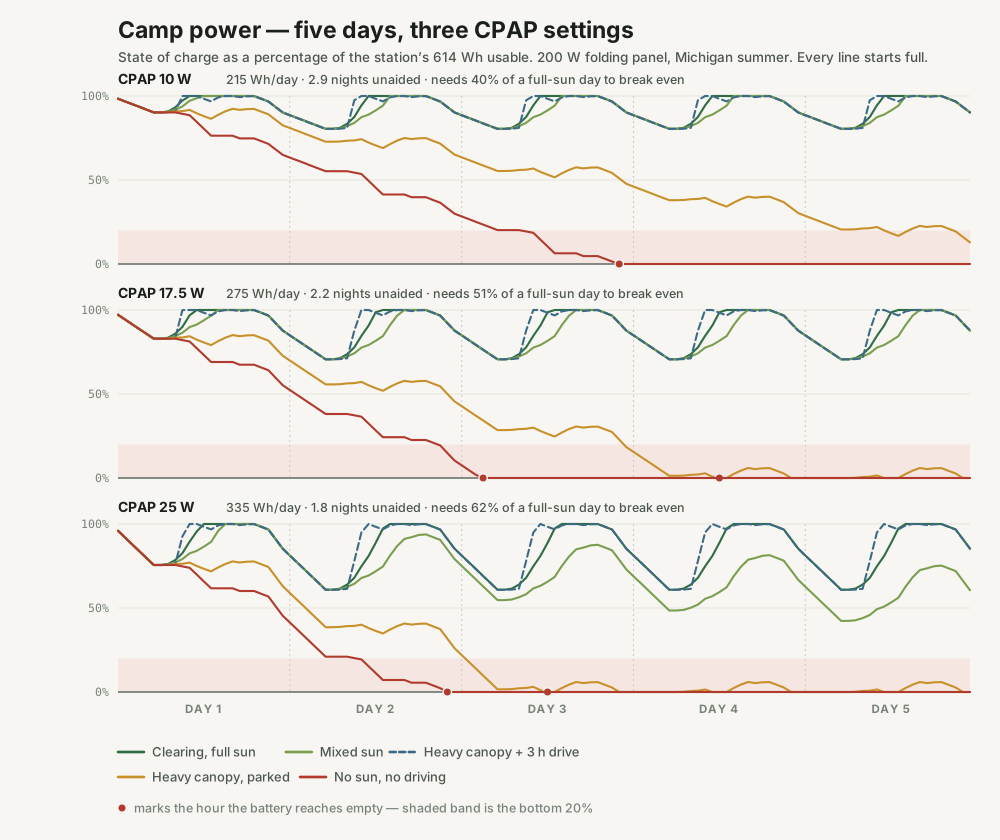
build_power_chart.py from this dive's own load table.⭐ Three things the model shows that the table above does not.
A shaded static camp is the case that fails, and it is the only one that does. Heavy canopy with the truck parked runs the battery flat on day 5, 4 or 3 as the CPAP draw climbs. ⭐ Three hours of driving on those same shaded days holds it above 60 percent indefinitely — which is why the vehicle charging path is worth the section it now gets rather than the footnote it had.
Mixed sun stops being sufficient at the top of the band. At 10 and 17.5 W it holds level; at 25 W it decays about six points a day. ⭐ That is the only scenario that changes character across the band, and it is the reason the panel is 200 W rather than 100.
🔴 On sunny days the panel is idle by mid-morning. The battery is full again before noon and the afternoon’s output is thrown away — between 1,100 and 1,700 Wh across five days depending on the setting. ⭐ That waste is not a sizing error. The panel is sized for the overcast week, not the sunny one, and the discarded surplus is what covering the bad days costs.
1.3 The battery-and-charger question, answered as one box
The brief asks for “a decent battery and charger” with 110 V charging. ⭐ A portable power station is exactly that, assembled: LiFePO4 cells, an MPPT solar controller, a mains charger, an inverter and the DC outputs, in one case.
A DIY 12 V bank is cheaper per watt-hour and is the right answer for a permanent installation — which is what the truck’s own system in Vehicle Power is. For a small, portable camp system it is more boxes, more wiring and more money.
1.3.1 The 768 Wh class
Three units, all LiFePO4, all around $379–400:
Table 3 — Three units, all LiFePO4, all around $379–400:
| Capacity | Inverter | Weight | Max solar in | Price | |
|---|---|---|---|---|---|
| ⭐ EcoFlow RIVER 2 Pro | 768 Wh | 800 W | 17.2 lb | 220 W | ~$379 |
| Bluetti AC70 | 768 Wh | 1000 W | 22.5 lb | 500 W | ~$399 |
| Anker SOLIX C800X | 768 Wh | 1200 W | 24.0 lb | ~300 W | ~$379 |
All three give 614 Wh usable. Against the real CPAP range that is:
Table 4 — All three give 614 Wh usable. Against the real CPAP range that is
| CPAP draw | Daily load | Nights with no sun |
|---|---|---|
| 10 W | 215 Wh | 2.9 |
| 17.5 W | 275 Wh | 2.2 |
| 25 W | 335 Wh | 1.8 |
⚠ Note the top of the band: 1.8 nights, not two. ⭐ The 768 Wh class works across the whole range, but at high prescribed pressure the margin is one night and most of a second — not two comfortable ones.
⭐ The EcoFlow RIVER 2 Pro is the pick, and the deciding factor is weight. It is five to seven pounds lighter than the other two for identical capacity and the same money. On a truck with 221 lb of truck-only payload, seven pounds is not a rounding error — it is three percent of everything available.
⭐ Its 800 W inverter being the smallest of the three turns out not to matter at all — see below. Nothing in this system uses AC.
⚠ Its 220 W maximum solar input is the one specification to note, because it sets the ceiling on the panel — and as it happens, 200 W is exactly the right panel anyway.
1.4 The panel — where the “one day” requirement bites
Michigan summer gives roughly 4.5 peak sun hours, and real-world yield after angle, temperature and controller losses is around 60 percent of nameplate.
Table 5 — The panel — where the "one day" requirement bites
| Panel | Real Wh/day | Covers 215–335 Wh/day? | Recharges 614 Wh in |
|---|---|---|---|
| 100 W | ~270 Wh | 🔴 only at the low end | 2.4 days |
| ⭐ 200 W | ~540 Wh | ✅ across the whole band | 1.1 days |
| 300 W | ~810 Wh | easily | 0.8 days |
🔴 The real CPAP range strengthens the case for 200 W rather than weakening it. A 100 W panel makes 270 Wh — which does not even cover the daily load at high pressure, let alone refill the battery.
🔴 A 100 W panel meets the daily load and fails the brief. It replaces what is used but takes nearly two and a half days to refill a drained battery. The stated requirement — recharged in a day of sunlight — requires 200 W, and that is the whole argument for the larger panel.
1.4.1 🔴 Buy the foldable kind, not the briefcase kind
This is a payload decision, not a preference.
A 200 W glass-and-aluminium briefcase panel weighs 35–45 lb. A foldable ETFE panel of the same output weighs about half that.
Table 6 — 🔴 Buy the foldable kind, not the briefcase kind
| Combination | Weight | Share of the 221 lb truck-only budget |
|---|---|---|
| Station + foldable panel | ~37 lb | 17% |
| Station + briefcase panel | ~57 lb | 26% |
⚠ Even the light version is seventeen percent of everything the truck can carry. The heavy version is out of the question.
⭐ And portability is not only about weight here. The Vehicle Power dive established that solar under Upper Peninsula canopy is “a bonus rather than a plan” — the campsite is in shade because campsites are in trees. A panel you can carry into a clearing and aim produces multiples of what a panel lying flat by the truck produces. A foldable panel with a cable is that; a 40 lb glass briefcase is not.
Options: the Renogy E.Flex 200 W is the current value pick and has been seen near $187; the Bluetti PV200 is comparable and pairs natively if the AC70 is chosen instead.
1.5 MPPT or PWM — and the part of it already decided
⭐ For the RIVER 2 Pro the question is answered by the purchase: it has MPPT built in. Its solar input is 11–50 V, 13 A, 220 W max through an XT60 connector, with the tracking already done. There is no controller to buy.
But the reasoning is worth having anyway, because it applies to the truck’s system, the trailer’s, and to any DIY route.
What the two do. A PWM controller connects the panel almost directly to the battery, dragging the panel down to battery voltage — so you harvest panel current at battery voltage, and the surplus voltage is simply lost. An MPPT controller is a DC-DC converter: it holds the panel at its maximum power point and turns that surplus voltage into extra current.
What that is worth, measured rather than claimed:
Table 7 — What that is worth, measured rather than claimed
| Effective output from a 200 W panel | |
|---|---|
| PWM | ~153 W |
| MPPT | ~194 W |
A 27 percent gain in that test, and the general range is 15–30 percent. ⭐ And the split is not uniform — MPPT gains about 31 percent in cold and about 18 percent in heat, because panels make higher voltage when cold and MPPT is what converts that surplus into current. Michigan shoulder-season camping is the favourable case, not the marginal one.
1.5.1 ⭐ The argument that actually decides it here is payload
To match MPPT’s output using PWM you would need about 254 W of panel instead of 200 — roughly 27 percent more panel, or about 5½ extra pounds of foldable.
🔴 So on a build with 221 lb of truck-only payload, MPPT buys back five and a half pounds for a forty-dollar part. That is the whole case, and it is a better argument than the efficiency percentage because weight is the thing this build is actually short of.
1.5.2 ⚠ What MPPT does not fix
Shade. Partial shading on a series-wired panel collapses its output regardless of what controller is downstream — one shaded cell string drags the whole panel down, and no tracking algorithm recovers it.
⭐ Under Upper Peninsula canopy, moving the panel into sun is worth far more than any controller choice. That is the same conclusion the panel section reached from the other direction, and it is the reason a portable panel beats a roof-mounted one here.
1.5.3 Two things to check against the input spec
⚠ Current, not just wattage. The input tolerates 13 A. A 200 W panel at an 18 V maximum-power voltage draws about 11.1 A — inside it, but not by a wide margin. A lower-voltage panel of the same wattage could exceed it. Check Vmp, not only the watt rating.
⚠ The connector. EcoFlow uses XT60; most third-party panels terminate in MC4 or Anderson. Buy the adapter with the panel, not after discovering it at a campsite.
1.6 The system, and what it costs
Table 8 — The system, and what it costs
| EcoFlow RIVER 2 Pro, 768 Wh | ~$379 · 17.2 lb |
| Renogy E.Flex 200 W foldable | ~$190–250 · ~20 lb |
| Total | ~$570–630 · ~37 lb |
Against the brief: small ✅, inexpensive ✅, decent battery and charger in one box ✅, 110 V charging built in ✅ (about 70 minutes to full), and recharged in a day of sun ✅.
1.7 ⭐ Settled: the system is DC-only, and that changes which specs matter
The owner’s decision: the CPAP runs on its 12 V DC adapter, so no inverter is needed. Working down the load table, nothing else needs one either — the lights are 12 V, the shower pump is 12 V, the RO charges over USB-C, the phones are USB. 🔴 There is not one AC load in the entire system.
⭐ That retires the specification everybody compares these units on. The 800 / 1000 / 1200 W inverter ratings separating the three contenders are irrelevant here. What matters instead is the DC side — the part that is usually weakest and rarely advertised.
The RIVER 2 Pro’s DC outputs:
Table 9 — The RIVER 2 Pro's DC outputs:
| Port | Rating |
|---|---|
| DC — car socket + two DC5521 | 12.6 V · 10 A / 3 A / 3 A · 126 W combined |
| USB-C | 5–20 V · 5 A · 100 W |
| USB-A | 12 W |
⭐ Both are comfortably adequate, and the USB-C is genuinely useful — 100 W refills the RO’s internal pack quickly rather than overnight.
The CPAP against the 10 A car port:
✅ ResMed’s own figure is 1–2 A at 12 V, against a 10 A port. Five to ten times the headroom, and even the 25 W top of the band sits well inside the 126 W combined DC ceiling alongside the lights. This question is closed.
⚠ One caveat worth writing down rather than discovering. The ResMed converter is rated 12 V at 13 A, and that rating is its maximum with the humidifier and heated tube running. 🔴 Humidifier-off it is a non-issue. If the humidifier ever comes back — a cold night, a dry winter — the 10 A port becomes the constraint, and the plan needs revisiting rather than just plugging in.
1.8 🔴 The trap that comes with a station whose AC side you do not need
Turn the AC output off, and leave it off.
An inverter draws idle current simply being energised — typically 5 to 10 W — whether or not anything is plugged into it.
Table 10 — 🔴 The trap that comes with a station whose AC side you do not need
| Idle draw | Over an 8-hour night | Share of the 255 Wh daily budget |
|---|---|---|
| 5 W | 40 Wh | 16% |
| 8 W | 64 Wh | 25% |
| 10 W | 80 Wh | 31% |
🔴 Left on around the clock it would consume between half and all of the daily budget powering nothing. ⭐ On a system with no AC loads at all, the most valuable habit in it is a button press. EcoFlow toggles AC output independently; use it.
1.9 Is a power station still right, if the inverter is dead weight?
Fair question once AC is off the table — and the answer is still yes, for different reasons than before.
Table 11 — Fair question once AC is off the table — and the answer is still yes, for different reasons than before.
| DIY part | Cost |
|---|---|
| 12 V 50 Ah LiFePO4 | $90–200 |
| MPPT controller | $40–80 |
| AC charger, 14.6 V | $40–70 |
| Fuse block, wiring, sockets | $30–50 |
| USB-C PD adapter for the RO | $15–25 |
| Total | $215–425 |
Against a RIVER 2 Pro at $329–379. ⭐ The DIY route saves very little and may cost more at the top end — and it arrives as a box of parts rather than a system.
What the station bundles that the parts list does not: MPPT control, a 110 V charger, USB-A and USB-C, a regulated 12 V output, a BMS, fusing, an enclosure, a handle — and ⭐ a state-of-charge display, which matters more than it sounds when a medical device is on the other end. Weight is a wash, roughly 17 lb either way once a DIY build has its box, controller and charger.
⭐ So: buy the station, ignore its inverter, and treat it as a 12 V battery that happens to come with a charger, a controller and a screen.
1.10 🔴 Two more things that will bite if they are not designed in
🔴 The Air10’s three-contact plug has a centre sense pin that appears in no ResMed document. The standing rule applies: the genuine ResMed converter, model 370003, and meter before cutting anything.
1. LiFePO4 must not be charged below freezing.
⚠ This is a Michigan problem, not a footnote. Lithium iron phosphate is damaged by charging below 0 °C. Reputable stations refuse to charge when cold — which means on a frosty shoulder-season morning the solar panel may be in full sun and the battery simply will not take it.
Discharging is fine in the cold. It is charging that is blocked. ⭐ Keep the station in the cab overnight in shoulder season — the same rule the water filters follow, for a different reason.
2. Size the cable to the panel, not to the plug.
A 200 W panel at roughly 18 V is about 11 A. Thin extension cable is how a panel walked into a clearing arrives at the battery delivering considerably less than it made. ⭐ If the panel is going to be sited away from the truck — which is the entire reason for buying a portable one — buy the heavier extension lead at the same time.
1.11 The third way in — charging from the truck
The dive above sized a panel and mentioned the 110 V charger, and then quietly stopped there. That left out the charging path most likely to be used, and it is worth stating plainly: the station has three ways in, not two.
The RIVER 2 Pro’s car input is 12/24 V, 8 A, 100 W maximum, and the car charging cable is supplied in the box alongside the AC cable and a DC5521 lead. There is no part to buy. What there is, is arithmetic worth doing before relying on it.
At 100 W a full refill of 614 usable watt-hours is about six hours of driving — slow enough that nobody should plan around it. ⭐ But a full refill is the wrong thing to measure. The daily load is 215–335 Wh depending on where the prescribed pressure sits, and replacing that takes 2.1 to 3.4 hours of driving. On a trip that moves between sites, the socket covers the day’s use on its own.
⭐ So the three paths divide by role, and none of them is a backup for the others in the ordinary sense. The panel is the primary source and the only one that works on a static camp. The socket covers days that involve driving, including the overcast ones where the panel makes little. The wall charger fills the station before departure. For a medical device that is three independent sources, which is the argument for having all three rather than the best one.
1.11.1 ⚠ Check whether the socket is ignition-switched
An ignition-switched socket is the desirable case: it cannot draw from the starting battery while the engine is off. Where a socket is permanently live, a station left charging overnight pulls roughly 8 A from the starting battery until morning.
⭐ This is the same failure the Trailer Build dive flagged for running a fridge off the 7-pin auxiliary line, arriving from the opposite direction — there the danger was a permanently live circuit feeding a continuous load, here it is a permanently live circuit feeding a charger. Both end with a truck that will not start. Establish which sockets in this truck are switched before the first trip, not after.
1.11.2 Why an alternator charger is not recommended here
EcoFlow sell a dedicated alternator charger that wires to the starter battery and charges much faster than a dash socket — 800 W at $289 plus roughly $30 for the XT60 output cable it does not include, or a 500 W version that does include it, at about 5 lb either way.
⚠ The original reason given here no longer holds, but the conclusion does. It was rejected because Vehicle Power specified a 40 A DC-DC charger and a second alternator tap would duplicate it. That DC-DC charger was never built. ✅ The recommendation still stands on its own merits: the River 3 Max Plus accepts 220 W from the truck’s ordinary 12 V socket, which refills a night of CPAP in under two and a half hours of driving. 🔴 With the fridge gone there is no continuous load to chase, so paying $289 and 5 lb to charge faster than the socket buys nothing this rig needs.
⚠ One specification here is genuinely unresolved and is not being rounded into a fact. The RIVER 2 Pro’s XT60 input is documented at 220 W maximum for solar, while EcoFlow’s own River-plus-alternator-charger bundle claims a full recharge in about 2.1 hours, which implies substantially more than 220 W going in. Those two figures cannot both describe the same port. Anyone revisiting this decision should establish what the unit actually accepts over XT60 from an alternator charger before paying for capability it may not be able to use.
1.12 What this does not cover
🔴 The fridge is out of the build entirely — not moved to the trailer, removed. It was a continuous load that would roughly double the daily figure on its own, and its removal is what let the whole fitted electrical architecture collapse into one 24 lb pack. This system is camp lighting, the CPAP, the RO, and the shower pump — and that is now the complete list.
🔴 And there is no truck bank to be independent of. Vehicle Power sized one at around 200 Ah with a 40 A DC-DC charger; it was never built, because removing the fridge removed the load that justified it. ⚠ That costs the redundancy this section claimed. With a single pack there is no second system to fall back on for a medical device — the three charging paths (socket, solar, AC) are now the only redundancy the rig has, and they are three ways to fill one battery rather than two batteries. That is a real reduction in resilience and it should be named rather than glossed.
1.13 The measurement that unblocks it
✅ SETTLED: ResMed’s own figure is 10–25 W with humidifier and heated tube off. ⭐ On the 858 Wh pack that is 3.9 nights at the top of the band and 9.6 at the bottom, against a two-night requirement — generous at either end, which is what made the smaller, lighter pack defensible.
⭐ Everything else in this dive is arithmetic on that one number, and the bench sheet has been waiting since June.
References
- 768 Wh LiFePO4 class, 2026: EcoFlow RIVER 2 Pro (800 W inverter, 17.2 lb, 220 W max solar, ~$379); Bluetti AC70 (1000 W, 22.5 lb, 500 W solar, ~$399); Anker SOLIX C800X (1200 W, 24 lb, ~$379).
- Portable 200 W panels: Renogy E.Flex 200 W (value pick, seen near $187); Bluetti PV200. Briefcase panels 35–45 lb against roughly half that for foldable ETFE.
- Vehicle Power, this project — the truck’s own bank, the DC-DC charger, the ResMed 370003 converter, and the finding that solar under Upper Peninsula canopy is a bonus rather than a plan.
- Water and Hygiene vols 3 and 8, this project — the shower pump and the RO unit’s charging load.
- Weight and Balance, this project — the 221 lb truck-only payload these weights are measured against.
- EcoFlow RIVER 2 Pro supplied accessories: AC charging cable, car charging cable, DC5521 cable. Car input 12/24 V, 8 A, 100 W max.
- EcoFlow 800 W Alternator Charger, $289, 5.1 lb, XT150 supplied and XT60 output cable sold separately; the 500 W version includes the XT60 cable. Not recommended for this build.
- Trailer Build vol 5, this project — the permanently-live auxiliary circuit failure, in its original form.
Tasks/CPAP/AS10-BENCH-SHEET.html— the outstanding measurement.
Comments (0)