Suspension And Armor · Volume 3
Running Boards, Rock Sliders, and Recovery Points — Three Parts That Look Related and Are Not
Introduction
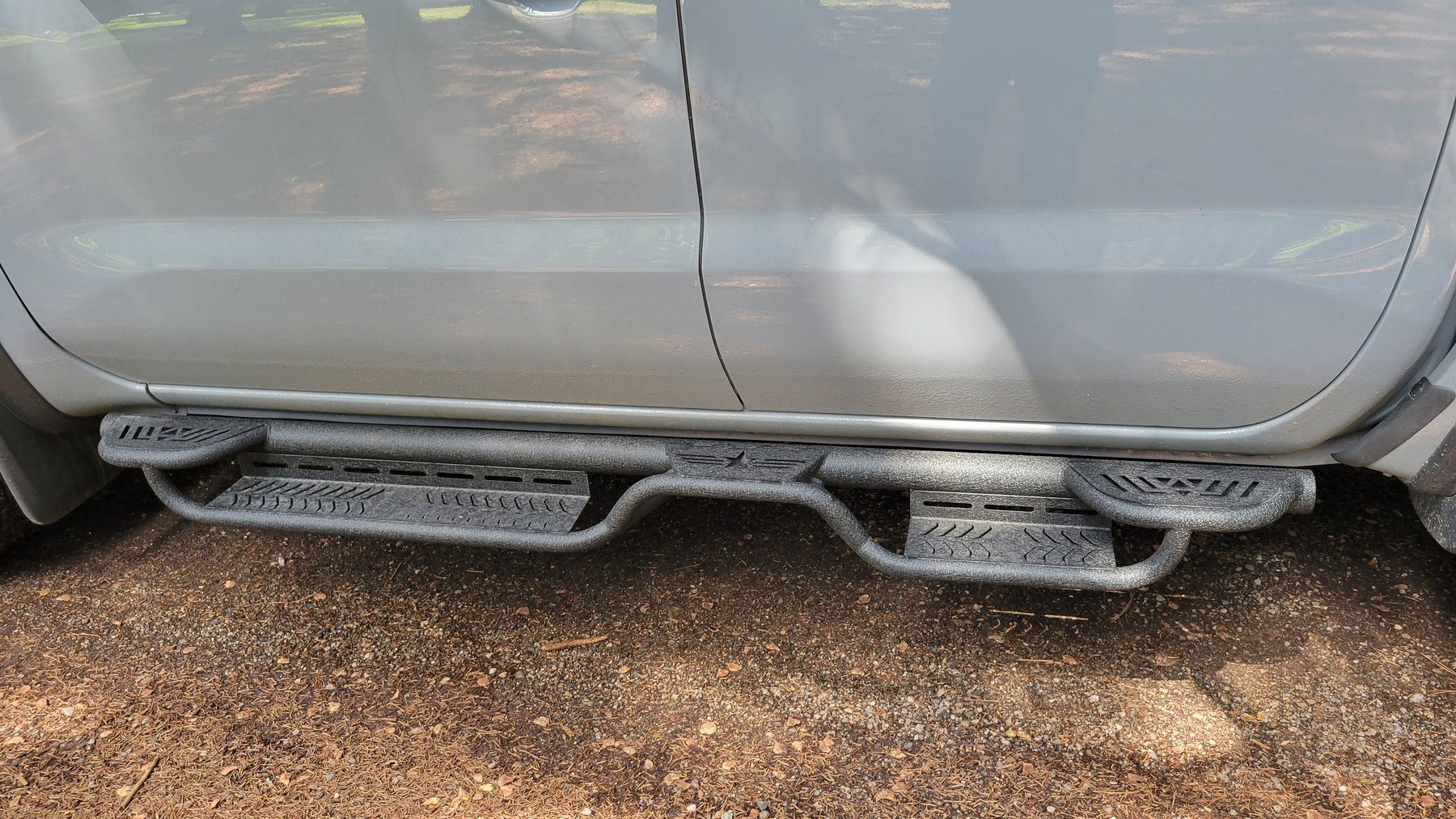
The EYOUHZ running boards arrive Friday. They fit the 2005–2026 Frontier Crew Cab, they are a bolt-on nerf bar with a three-step, two-stair profile in black, and they will make getting into a truck that is about to get taller considerably easier.
The finding: a running board and a rock slider occupy the same place on the truck and do opposite jobs, and the difference is entirely in what they bolt to. One is a step that hangs off sheet metal. The other is structure that hangs off the frame and will hold the truck’s weight. Confusing them is how rocker panels get destroyed, and the confusion is easy because the two parts look similar from ten feet away.
The same distinction runs through the third part in this volume. A factory tow hook and a rated recovery point look alike too, and that confusion is the one that hurts people.
3.1 What is arriving Friday, and what it is
The EYOUHZ boards are a nerf bar: tubular side steps that mount below the rocker panel on brackets. That is a genuinely useful part on this build, and its value is about to increase — a truck carrying a bed rack and a rooftop tent is a truck people climb rather than step into, and a step at the right height is worth having every single day.
What a nerf bar is good for is stepping, keeping road spray and stone chips off the lower doors, and taking the occasional car-park knock. On a truck that will spend most of its life on pavement, that covers most of what actually happens to a rocker panel.
What a nerf bar is not is protection. Light-duty side steps are not built for off-road use, and the reason is the mounting rather than the tube. Nerf bars typically pick up the rocker pinch weld or body-mount points — sheet metal, not frame rail. A real impact does not bend the bar; it tears the mount out of the bodywork, and the repair is a rocker panel rather than a step.
🔴 Two rules follow, and they should be written on the receipt: never jack the truck on the running boards, and never let the truck’s weight rest on them. The recovery jack that comes out when the rig is stuck goes under the frame or the axle, never under the step. A nerf bar will hold a person stepping up. It will not hold four and a half thousand pounds of truck, and the failure takes the bodywork with it.
3.2 The photograph to take on Friday
⭐ The single most valuable thing to do this week takes five minutes and becomes impossible after the boards go on.
Before anything is bolted up, photograph the mounting points the boards will attach to, on both sides, with something in frame for scale. The question the photograph answers is the one the product listing will not: do these brackets pick up the frame rail, or do they pick up body mounts and the pinch weld?
That answer determines what the part may be used for, and it determines whether rock sliders can be added later without removing them. It is also a fitment record — if a bracket ever cracks or a bolt pulls, the before-image is what makes the diagnosis obvious.
Take the after-images too, from the same positions. This is the “before and after” pair the project’s photo plan already calls for, and Friday is the only day it can be taken.
🔴 Check every frame for the licence plate and for the door-jamb sticker before any image is committed. The door jamb is open during this job, which is exactly when the VIN sticker ends up in a photograph by accident.
3.3 Rock sliders, which are a different part
A rock slider is what the running boards are not. It is heavy-wall steel tubing — commonly 3/16 or 1/4 inch — on plate brackets that bolt through the frame rail, mounted tight against the body just under the door sill. It is designed to take the truck’s weight on a boulder and slide off it, which is where the name comes from.
The mounting is the whole distinction. A slider bolted to a pinch weld is a running board with thicker tube and worse manners; a slider bolted through the frame is structure. Any product that will not say which it does should be assumed to be the former.
Whether this truck needs them is a genuine question, and the answer is probably not yet. Sliders earn their weight on rock, where a rocker panel meets a boulder. The terrain in this project’s plans — Upper Peninsula forest roads, two-tracks, gravel, sand — is not rock-crawling terrain, and a rocker panel is rarely what makes contact there. Set against that:
- A pair of frame-mounted sliders is heavy, commonly well over a hundred pounds for the set, and this build has already been shown to be at its payload limit before the trailer’s tongue weight is counted. The weight lands low and centrally, which is the best place for it, but the payload figure does not care where it sits.
- ⚠ Sliders and running boards compete for the same mounting real estate. Fitting boards now may mean removing them to fit sliders later, and some slider designs incorporate a step for exactly this reason. If sliders are a serious future intention, that is worth knowing before Friday’s boards are torqued down — though it is not a reason to delay a part that is already paid for and useful.
The sequence that makes sense: fit the boards, use the truck, and let the terrain make the case for sliders. If the rockers come back unmarked after a season in the U.P., the case has been made in the other direction and the weight is better spent elsewhere.
3.4 Recovery points, where the confusion is dangerous
This is the part of the volume that matters most, and it is the one most often got wrong.
The PRO-4X leaves the factory with two hooks at the front. They look exactly like recovery points. They are, on the available evidence, not recovery points, and the distinction is not pedantry.
Nissan does not publish a load rating for them. Owner discussion on this platform is consistent that the front hooks are intended for tying the truck down in transit and for dragging light loads, not for extracting a stuck vehicle, and that the hook or its bolts are the failure point under real recovery loads.
🔴 The rule that covers this safely is simple: an unrated attachment point is not a recovery point. It is not “probably fine,” because the loads involved are not intuitive. A kinetic recovery rope works by stretching and releasing stored energy, and the peak force it delivers can be several times the stuck vehicle’s weight. When an unrated hook fails under that load, it does not merely let go — the hook, the bolts, and the rope become projectiles travelling back along the line, which is where recovery fatalities come from.
What to do about it, in order:
- Establish what the front hooks actually are. The place to settle it is the Warranty Information Booklet and the owner’s manual’s towing and recovery section — the same documents the Service Schedule dive is already waiting on. If Nissan states a rating, that is the answer; if Nissan declines to state one, that is also the answer.
- Use the rear receiver for rearward recoveries. The truck has a Class IV receiver and the equipment list already carries a Rhino 6-inch adjustable hitch receiver. A properly rated receiver shackle mount in that receiver is a legitimate, engineered recovery point, and it is the strongest one on the vehicle without modification. 🔴 Never attach a recovery line to a tow ball. A ball loaded sideways or upward shears off, and a detached ball on a stretched rope is the classic recovery projectile.
- Treat proper front recovery points as part of the front bumper decision, not a separate purchase. The previous volume concluded that the only front-end path with real capability is a replacement bumper with an engineered radar relocation. Rated front recovery points come with that decision — which is a point in its favour that the bull bar conversation entirely missed, and one of the few things that would justify its weight.
Until a front recovery point is established, plan recoveries rearward. That is a real operational constraint and it should be known in advance rather than discovered at the bottom of a two-track.
3.5 What this volume settles
The running boards are a good part doing a modest job, and Friday’s install is a photograph opportunity as much as a fitting. They are not armour and must never be jacked on.
Rock sliders are a real upgrade for terrain this truck may not actually see, and they cost payload the build does not have. Let the rockers earn them.
The front hooks should be treated as unrated until the manual says otherwise, recoveries should be planned rearward off a rated receiver shackle, and rated front recovery points belong to the front bumper decision rather than to this one.
References
- Nissan Frontier owner community discussion of PRO-4X front hook ratings — consistent reporting that the hooks are transit tie-down and light-dragging points, and that Nissan publishes no recovery rating.
- Ranch Hand, on nerf bars versus running boards — light-duty side steps are not intended for off-road use.
- Off-road community technical writing on slider mounting — frame-rail brackets in 3/16 or 1/4 inch plate versus body and pinch-weld mounting, and the jacking prohibition on body-mounted steps.
00-inventory/equipment.md, this project — EYOUHZ running boards and the Rhino adjustable hitch receiver.- Recovery Gear, this project — the recovery kit these attachment points serve.
Comments (0)