Bed Rack And Awning · Volume 2
The Rack Is Not the Binding Constraint — the Payload Sticker Is
Introduction
The obvious limit on what this truck can carry is the rack’s 450 lb dynamic off-road rating, and every rack discussion treats it as the ceiling. Working through the actual numbers produces a different and more uncomfortable answer: the rack has room to spare, and the truck does not.
This volume is the arithmetic. It is the most consequential thing in this dive, and it should be settled before the rooftop tent is bought, because the tent is the last large item that can still be chosen freely.
2.1 The number that actually governs
Every truck carries a yellow payload sticker on the driver’s door jamb reading, in substance, “The combined weight of occupants and cargo should never exceed X lb.” That figure is specific to the individual vehicle as built — it accounts for the actual options fitted — and it is the number that matters legally and mechanically.
It is not the same as the brochure figure, which describes a base configuration. A PRO-4X crew cab carries heavy off-road equipment, and heavier trim means lower payload. Mid-size trucks are also, as a class, far more payload-limited than their capability suggests; it is entirely normal for a well-equipped mid-size crew cab to have less usable payload than buyers assume.
✅ CONFIRMED FROM THE TRUCK: this truck’s payload is 1,100 lb — the door-jamb Tire and Loading Information label, “the combined weight of occupants and cargo should never exceed 1100 lbs or 499 kg.” ⚠ Not the 1,220 lb the brochure gives for this configuration; the label accounts for the options actually fitted. Every number below is now measured against a real constraint rather than an assumption.
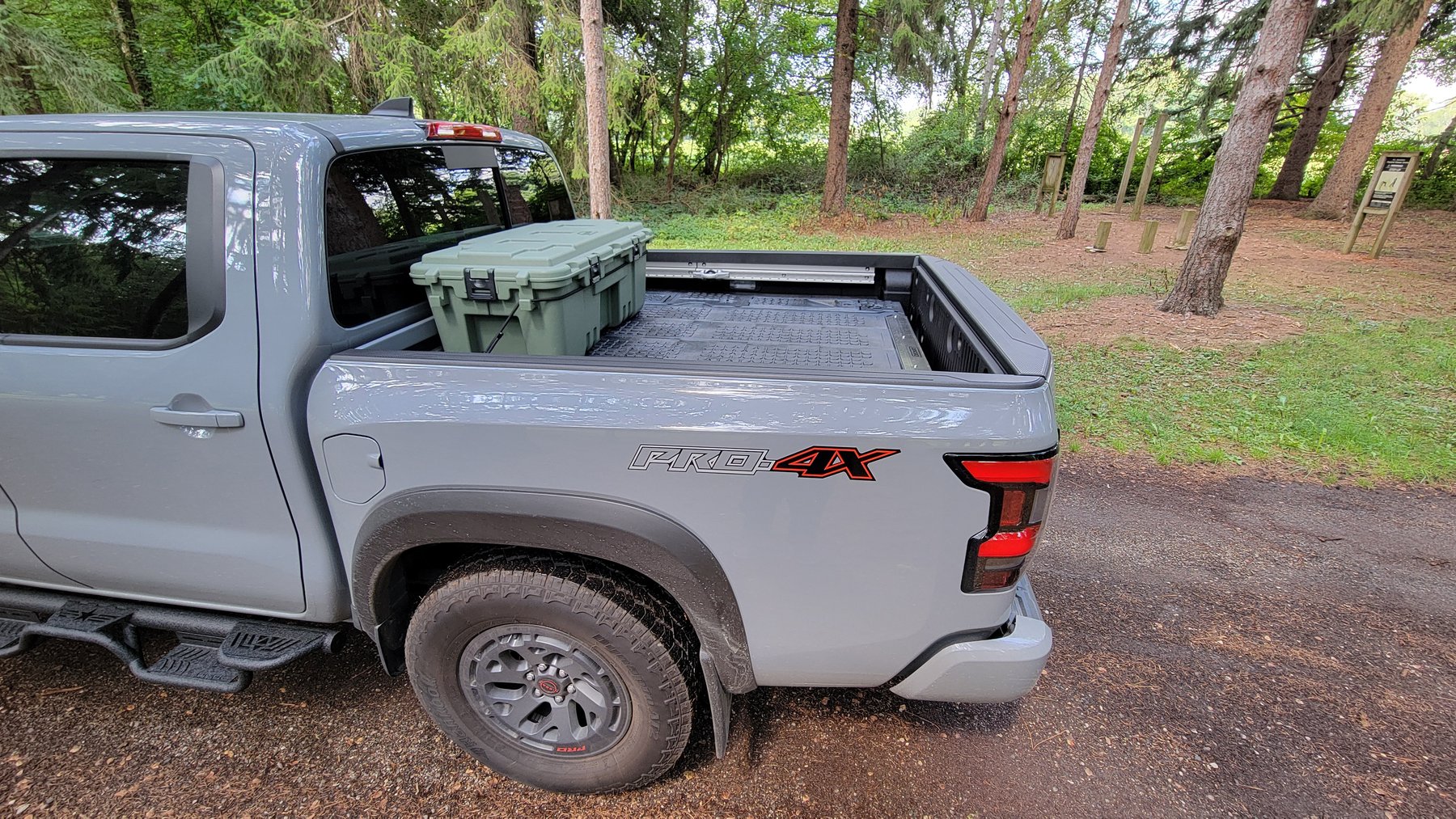
⭐ The trim and the fitted options together cost 230 lb. Nissan publishes 1,330 lb for the base Crew Cab 4x4 and 1,220 lb for the PRO-4X — the Bilstein shocks, the locking differential, the skid plates and the all-terrain tyres are themselves weight. 🔴 And this truck’s own label reads 1,100 lb, a further 120 lb below the brochure figure, because the published number is a maximum for the configuration while the door-jamb label accounts for the options actually fitted. The trim that is best at going off-road carries the least gear off-road — and the options make it worse.
The revised load plan against that number is the next volume, and it is not comfortable reading.
🔴 One caution specific to this project: the payload sticker shares the door jamb with the VIN sticker. If it is photographed for the record, crop or obscure the VIN before the image goes anywhere. Reading the number and writing it down is safer than photographing it.
2.2 Everything that counts against it
Occupants count. This surprises people and it is the largest single line in most real budgets. ✅ Measured for this build on 2026-08-31: 220 and 172, so 392 lb before anything else is loaded — 36 percent of the label, and 42 lb more than the 175-each placeholder the project had carried.
Permanently fitted equipment counts, because it was not on the truck when it was weighed for the sticker.
Trailer tongue weight counts. A trailer is not carried by the truck, but its tongue is — typically 10 to 15 percent of the trailer’s loaded weight, pressing straight down on the hitch. A 2,000 lb trailer puts 200–300 lb onto the truck’s payload. For a project that includes building a trailer, this is not a footnote.
2.3 The budget, with real numbers where they exist
Table 1 — The budget, with real numbers where they exist
| Item | Weight | Source |
|---|---|---|
| Two adults | 392 lb | ✅ MEASURED 2026-08-31 — 220 and 172 |
| DECKED drawer system, midsize 5 ft bed | 177 lb | Manufacturer — ⚠ corrected from 204 lb, which is the full-size system |
| Rooftop tent, Smittybilt Gen2 Overlander XL | 139 lb | Manufacturer, net — the 148 lb figure everywhere is gross shipping weight |
| XTR3 bed rack, 26 in | 115 lb | Measured 2026-08-25 — the 130–170 lb class estimate was well high |
| EYOUHZ running boards, pair | 55 lb | Estimate — never budgeted until 2026-08-31 |
| Topoak 270° awning + 18 in uprights | 64 lb | Manufacturer. ✅ Confirmed 2026-08-31 by unpacking it — the 64 lb covers the uprights, so there is no additive 20–30 lb surprise |
| Radios, antennas, cabling, mounts | ~35 lb | Estimate |
| EcoFlow River 3 Max Plus, 858 Wh | 24 lb | Manufacturer |
| VIAIR 450P-A EF compressor kit | 17 lb | 13.0 lb net + bag, hose, gun — estimate for the packed kit |
| Renogy 200 W portable panel | 13.9 lb | Manufacturer |
| Water filter, hybrid + RO | 13 lb | Owner |
| Water, 1 gal reserve | 12 lb | Physics — water is 8.34 lb/gal |
| Bedding, in the tent | 8 lb | Estimate — a sheet and a light bag |
| Clothing and personal kit | 8 lb | Estimate |
| Tyre field kit — gauge, plugs, deflators | 3 lb | Estimate |
| Tools, spares, recovery kit | ~80 lb | Estimate |
| Camp kit and food | ~65 lb | Estimate |
| Recovery boards, pair | 22 lb | Class figures |
| Trailer tongue, if towing | see below | 10–15% of the trailer’s loaded weight |
🔴 Out of the build, and deliberately not listed above: the fridge, the 200 Ah house battery (never built), the Anker SOLIX F3000, and the fuel Rotopax. ⚠ They were struck through here once and that was the wrong fix — a weight table that lists an item is asserting the item is aboard, and the subtotals summed them regardless of the annotation. A budget contains the budget.
⭐ The live figures are generated from the loadout calculator in Weight and Balance volume 3 and cannot drift. The table above is the reference list of what things weigh; volume 3 is what the truck actually carries on a given trip.
Add the permanently fitted equipment alone — DECKED 177, rack 115, awning 64, running boards 55, radios 35, tent 139 and its bedding 8 — and the truck carries 593 lb before a person, a tool or a litre of water is aboard.
Add two adults and it is 943 lb of an 1,100 lb payload. Add the power station, compressor, panel, filter, water, recovery gear, tools and camp kit and the no-trailer figure lands at about 1,206 lb, with the trailer’s tongue still to come if it is going.
Compare that to a mid-size crew-cab payload sticker and the problem is visible immediately. This is not a rack problem. The rack’s 450 lb dynamic limit is comfortably satisfied — awning, tent, uprights and antennas together are perhaps 280 lb, well inside it. The truck is what runs out.
2.4 What this means, practically
The rooftop tent choice is a payload decision, and it is the last large one still open. Everything else on the list is bought, ordered, or effectively fixed. The 40 to 80 lb difference between a heavy hardshell and a light softshell is one of the few remaining places to recover real capacity — and it is worth spending deliberately rather than by default.
The Anker SOLIX F3000 deserves re-examination on these grounds alone. At 91 lb and 3,072 Wh, it is a home-backup product — the manufacturer’s own description mentions a wheeled suitcase design, which is a fair summary of what it is for. For a rig whose main electrical load is a fridge drawing 30 to 40 Ah a day, it is roughly ten days of autonomy in a single 91 lb lump, and 91 lb is more than half a rooftop tent. The Vehicle Power dive treats the sizing question properly; the payload point is that this one item costs as much capacity as a substantial amount of camp kit.
Liquids should be carried low and, where possible, not carried at all. Water is 8.34 lb per gallon and fuel is roughly 6 to 7. This is the line item most easily reduced by planning — filling water at the last town rather than carrying it from home is free capacity.
The trailer changes everything, in both directions. Tongue weight is a payload cost, but a trailer is also the correct answer to a payload problem: water, fuel, recovery gear, and camp kit moved to the trailer come off the truck’s sticker entirely. For a build that is already near its limit, the trailer is not an accessory — it is the capacity fix, and that reframes the Trailer Build dive from “a nice project” to “the thing that makes the rest of the load plan work.”
2.5 Why this matters beyond a number on a sticker
Exceeding payload is not a paperwork offence. It has three concrete effects, in rising order of seriousness:
Handling and braking degrade, and they degrade most in exactly the conditions the equipment was bought for — loose surfaces, off-camber tracks, and emergency stops.
Centre of gravity rises, which is the specific risk of rack-mounted loads. A tent, an awning, and fuel at roughly 26 to 38 inches above the bed rails (⚠ corrected from 44 — see vol 1) move the vehicle’s centre of mass upward and meaningfully reduce rollover margin on side slopes. This is why the recommendation to carry liquids low is a safety recommendation rather than a tidiness one.
Components fail earlier — tyres above all, which are load-rated, and then wheel bearings, springs, and brakes. A tyre failure on a loaded truck on a remote two-track is the scenario the whole rig exists to handle, and overloading is the most common way to cause it.
2.6 The recommendation
- ✅ Done — payload is 1,100 lb. The next volume works the whole budget against it.
- Weigh the truck loaded, at a public scale, before a long trip. A certified scale costs a few dollars and replaces every estimate in the table above with a fact. Weigh it as it will actually be driven, with water, fuel, people, and the trailer connected.
- Choose the rooftop tent with the remaining budget in hand, not before — the subject of the Rooftop Tent dive.
- Treat the trailer as the capacity solution, and plan which loads move to it.
- Re-check tyre load ratings against the actual measured axle weights once they are known.
References
- DECKED — drawer system for the 2022+ Nissan Frontier 5 ft bed: 177 lb, 1,000 lb system payload, 400 lb per drawer. 🔴 Corrected 2026-08-30. The 204 lb previously recorded here is the full-size system; the payload figures beside it were always the midsize ones, so the row mixed two products.
- Xtrusion Overland — XTR3 specifications: 450 lb dynamic off-road, 850 lb dynamic on-road, 1,550 lb static; 1530 aluminium extrusion.
- Topoak Overland — 270° awning, 83 in “Wide Shade”: 64 lb, packed 84 × 8 × 11 in.
- Anker — SOLIX F3000: 3,072 Wh, 3,600 W, just over 91 lb.
- Rooftop tent class weights: softshell typically 100–140 lb, hardshell typically 140–180 lb.
- The vehicle’s own door-jamb payload label, which supersedes every published figure.
Comments (0)