Bed Rack And Awning · Volume 4
The Load Plan Against 1,100 lb — What Has to Give
Introduction
⚠ SUPERSEDED IN PART, 2026-08-30. ⚠ The payload budget below is superseded. Its figures predate six corrections — DECKED at 177 lb, a 139 lb softshell tent, bedding at 8 lb, clothing at 8 lb, water at one gallon plus a filter, and the power system replaced by a 24 lb EcoFlow. 🔴 And it models only the trailer-coupled case. The current numbers, generated from the calculator rather than hand-typed, are in Weight and Balance vol 3.
The payload figure is confirmed: 1,100 lb. The previous volume built the budget but had to leave the ceiling as an unknown. With the number in hand the arithmetic closes, and the result is worse than the earlier estimate suggested.
🔴 THE FINDING, and it is the reason the trailer exists: the truck ALONE does not fit inside its own payload. As first written this volume put it at roughly 300 lb over; the last no-trailer figure was 120 lb over, and the gap narrowed because estimates were replaced by real weights rather than because anything was given up. Every easy saving pulled together did not close it.
⭐⭐ What closed it was not a saving at all — it was the owner’s 2026-09-03 policy that a trailer is ALWAYS attached, with the gear in bins that move between the two trailers. The truck now carries only what is bolted to it, riding in it, or medical: 974 lb. ✅ Coupled, it lands at 1,075.5 lb — under the 1,100 lb label by 24.5. That is the proof that the trailer is a structural requirement rather than a project, and it changes what the trailer has to be. → Weight and Balance vol 3.
This volume is the working. Numbers marked est. are class figures or estimates carried forward from the previous volume and should be replaced by real weights as parts arrive.
4.1 The budget, totalled
⚠ This table is generated by build_weight_tables.py from the same item list the loadout calculator uses. An earlier revision of this volume carried a hand-typed snapshot here, and it went stale exactly as the note below predicted — running boards at a 55 lb estimate against 47 measured, radios at 35 against 19.8, two adults at 350 against a measured 392, and no line at all for the hitch or the step stool. The snapshot has been deleted rather than annotated.
Table 1 — The budget, totalled
| Weight | Note | |
|---|---|---|
| Truck — fixed equipment | 577 lb | DECKED 177 · tent 139 · rack 115 · awning and uprights 64 · running boards 47 · radios 19.8 · hitch 15.2 |
| Truck — two adults | 392 lb | MEASURED. The largest line in the budget, and the one always forgotten |
| Truck — systems | 5 lb | CPAP kit 5 |
| Tongue weight from the trailer | 101.5 lb — 8.50% | 🔴 17.9 lb BELOW the 10% sway floor. Close it by moving load FORWARD, never by trimming tongue. MEASURE it, do not infer it |
| TRUCK TOTAL — trailer coupled, THE BASELINE | 1,075.5 lb | ✅ under the 1,100 lb label by 24.5 |
| Trailer gross | 1,194.1 lb | against a 2,000 lb load rating — 40% used |
| Retired no-trailer case, contrast only | 1,220.1 lb | over by 120.1 — ⚠ not a configuration the owner plans. A trailer is always attached |
🔴 Not weighed, not estimated, and therefore counted as nothing above: Camp chairs, pair, Camp grill. Every total on this page is a lower bound.
🔴 Removed from the build and therefore absent above: the fridge, the 200 Ah house battery (never built), the Anker SOLIX F3000, and the fuel Rotopax. ⚠ An earlier revision struck them through instead of deleting them, and the subtotals went on summing them — 91 + 55 + 62 + 10 gave a “Systems subtotal” of 218 for a system that no longer existed. A struck-through row in a budget is still a row in the budget.
⭐ The table above IS the live one now — the same generator writes it here and into Weight and Balance volumes 1 and 3, so all three cannot disagree. ⚠ The prose around it still has to be maintained by hand, which is where this project’s errors have actually lived.
⚠ The retired no-trailer row excludes tongue weight entirely, correctly — there is no trailer in that configuration. It is kept for contrast and is not a trip the owner plans. On the live baseline the tongue does land on payload, and it adds 101.5 lb to the 974 lb of truck items. → Weight and Balance vol 3.
4.2 Every lever, ranked by pounds per unit of pain
The useful question is not “is it over” but “what is the cheapest 300 lb to find.” Ranked by how little capability each one costs:
⚠ All four of the levers this volume identified have since been taken. They are kept as the record of what was available and what each was worth.
Table 2 — Every lever, ranked by pounds per unit of pain
| # | Lever | Saved | Outcome |
|---|---|---|---|
| 1 | Take the Anker F3000 out of the truck | 91 lb | ✅ Taken. It is out of the build entirely, not merely out of the truck — an EcoFlow River 3 Max Plus at 24 lb replaced it |
| 2 | Softshell tent instead of hardshell | 26 lb | ✅ Taken, reversing the hardshell decision. The Smittybilt Gen2 XL is 139 lb net against the 165 lb budgeted. ⚠ This volume previously recorded it as declined |
| 3 | Fill water at the last town, not at home | 41 lb | ✅ Taken and then exceeded. The plan is now 1 gallon carried and the rest made on site with a 13 lb filter |
| 4 | Carry the fuel Rotopax only when the trip needs it | 20 lb | ✅ Taken. Removed from the load plan altogether |
🔴 So the cheap levers are spent — and they turned out not to be what closed the budget. ⭐ The bins policy did. What remains on the truck is not free: tools and spares at 49.7 lb, measured and the camp kit at about 50 lb are the two largest open items, and they are the least comfortable things to cut on the trip that needs them most. ⭐ DECKED is not on this list — the owner has settled that it stays unconditionally, over payload or not, and this project should stop offering it. ⭐⭐ And the largest lever left is not gear at all: the driver is 220 lb against 280 six months ago, heading for about 157. That is 63 lb, it costs nothing, and it is more than half the overage — 🔴 but it is not banked, so the truck must be planned against today’s figures.
⚠ And two items arrived after this table was written and were never budgeted at all: the running boards (55 lb) and the compressor kit (17 lb). The list of levers got shorter while the list of loads got longer, which is the honest shape of the problem. | 5 | Trim tools and spares toward the low estimate | 25 lb | Some self-sufficiency. Do this deliberately, not by forgetting things | | | All available (tent declined) | 198 lb | |
⚠ The arithmetic in this paragraph is superseded — it was drawn against the brochure’s 1,220 lb and a heavier parts list. The live figures are in the generated table above: 974 lb of truck items, 1,075.5 lb coupled, under the 1,100 lb label by 24.5.
⭐ That is the whole argument in one line. The gap is not a packing problem. Every soft saving available has been taken and the truck is still over its sticker. Note that levers 3 and 4 — water and fuel — are consumables that now move to the trailer anyway, so they are not additive with the trailer plan below; they are listed here to show that the truck cannot be fixed by packing alone.
4.3 What the trailer actually buys, and why it is not one-for-one
⭐ The trailer is no longer hypothetical. It is a Haul-Master 5 ft × 10 ft (SKU 59846), kit-built, 400 lb tare, 2,000 lb load capacity, carrying two kayaks and two e-bikes on an 80/20 1530 rail system, with a large front storage area for the Plano 108 qt trunk and the fridge. The Trailer Build dive covers it in full; this section covers only what it does to the truck’s number.
The instinct is that moving 300 lb to a trailer removes 300 lb from the truck. It does not.
A trailer converts cargo weight into tongue weight at roughly 10 to 15 percent of the trailer’s total loaded mass — its own tare included. Moving gear off the bed is strongly favourable, but the exchange rate is not 1:1, and the trailer’s own weight is charged to the truck too.
⚠ This section’s table is deleted, not annotated. It described a truck carrying a hardshell tent, an Anker F3000 and a house battery, with the fridge and all consumables on the trailer — four things that are no longer true of the build. The current truck load is 974 lb before the tongue, itemised in the generated table at the top of this volume.
🔴 REBUILT 2026-09-01. The two tables that stood here were computed against the brochure’s 1,220 lb payload while their column headings said 1,100 — so the second one marked a 1,190 lb truck total as “under by 30” when it is 90 lb over the label. Both are replaced by one table on the current trailer.
The trailer grosses 1,194.1 lb, and the truck carries 974 lb before the tongue is added:
Table 3 — The trailer grosses 1,194.1 lb, and the truck carries 974 lb before the tongue is added
| Tongue | Weight | Truck total | vs the 1,100 lb label |
|---|---|---|---|
| 8.50% | 101.5 | 1,075.5 | ✅ under by 24.5 — where the rig sits today, and BELOW the sway floor |
| 10.00% | 119.4 | 1,093.4 | ✅ under by 6.6 — the minimum STABLE tongue |
| 10.55% | 126.0 | 1,100.0 | ⚠ exactly on the label — the payload ceiling |
| 12% | 143.3 | 1,117.3 | 🔴 over by 17.3 |
| 15% | 179.1 | 1,153.1 | 🔴 over by 53.1 |
⭐⭐ Two rows now pass, and that is the finding. For most of this project every row was over — the tongue the trailer needed in order not to sway was one the truck could not legally carry. The bins policy opened a real window: 119.4 to 126.0 lb, or 10.00 to 10.55 percent.
⚠ It is 6.6 lb wide, and the rig is below it rather than inside it. 🔴 Only the bottom edge of the conventional 10–12 percent band is affordable, and a single-axle trailer normally wants the upper half. ⭐ The lever that widens the window is trailer gross — every pound off the trailer lowers the floor while leaving the ceiling alone. → Trailer Build vol 3.
⚠ But tongue weight must not simply be minimised. Below about 10 percent a trailer sways, and highway sway builds on itself. The target is to land deliberately in the 10–12 percent band and know the number. ⭐ And the trailer turns out to have a trim control: the 80/20 rail runs five feet front to back centred over the wheels, so the water Rotopax can be positioned along it — worth roughly 48 lb of tongue authority per 100 lb of water, most of the 66 lb spread. Trailer Build vol 2 works through where to put it, and the trap that consumables shift the trim as they are used.
4.4 The tent: hardshell, decided
The earlier arithmetic made the rooftop tent the swing item, and on payload grounds alone the softshell was the lighter answer. The owner’s decision is the hardshell, and every number above is built on it.
That decision is affordable — but it is what consumes the margin. The 45 lb difference is very close to the entire remaining headroom, which is why the Anker’s 91 lb and the tongue-weight band are no longer optional trims but the two things holding the plan together. With the hardshell fitted there is no third lever left that costs nothing.
⚠ The practical consequence is that this build has no slack for surprises. A fourth passenger, a full second water can, or an 80/20 rail system heavier than the estimate all land directly on a margin measured in single-digit pounds.
4.5 What the biggest lines say
Two entries in the budget deserve a harder look than they have had.
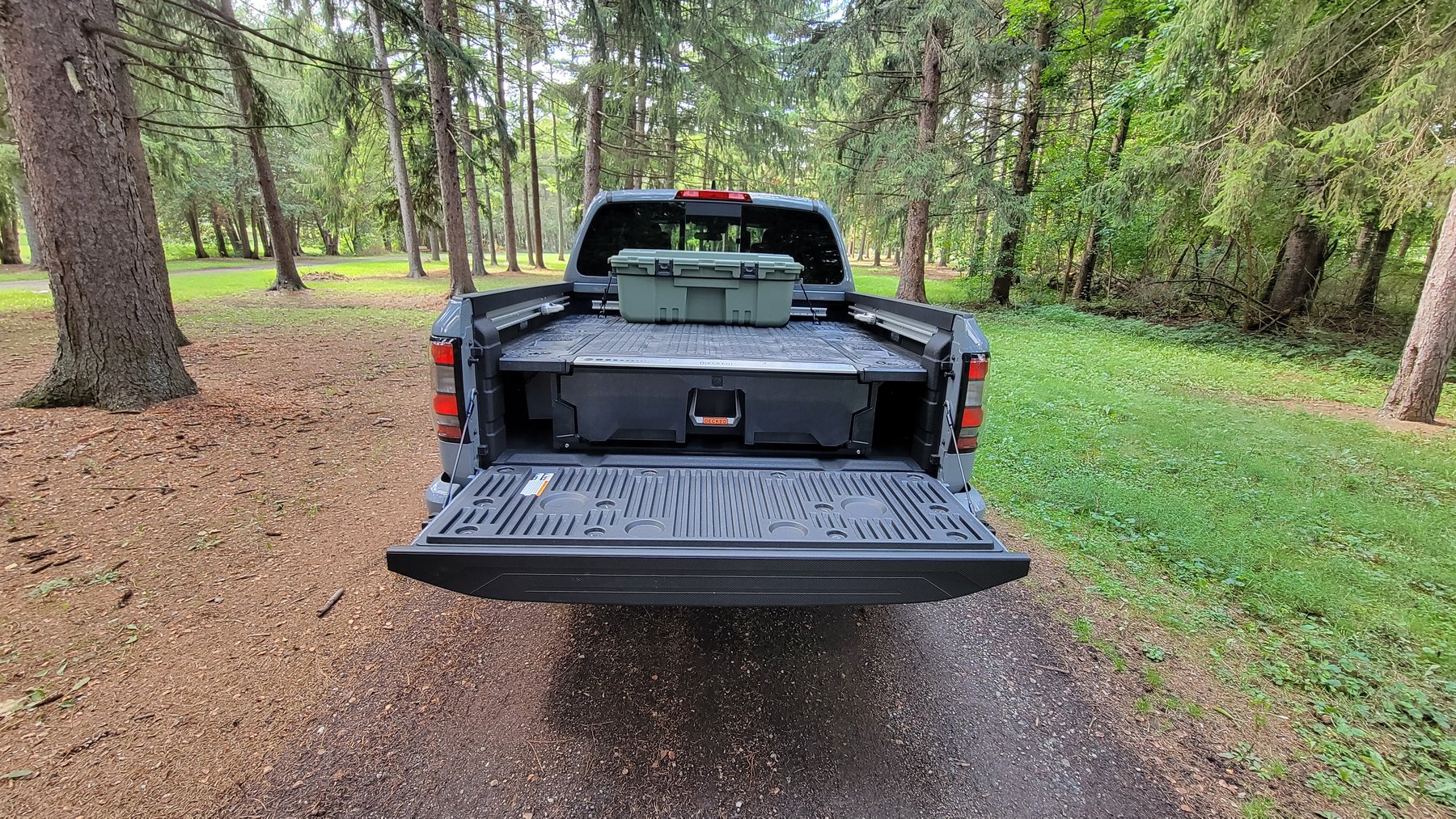
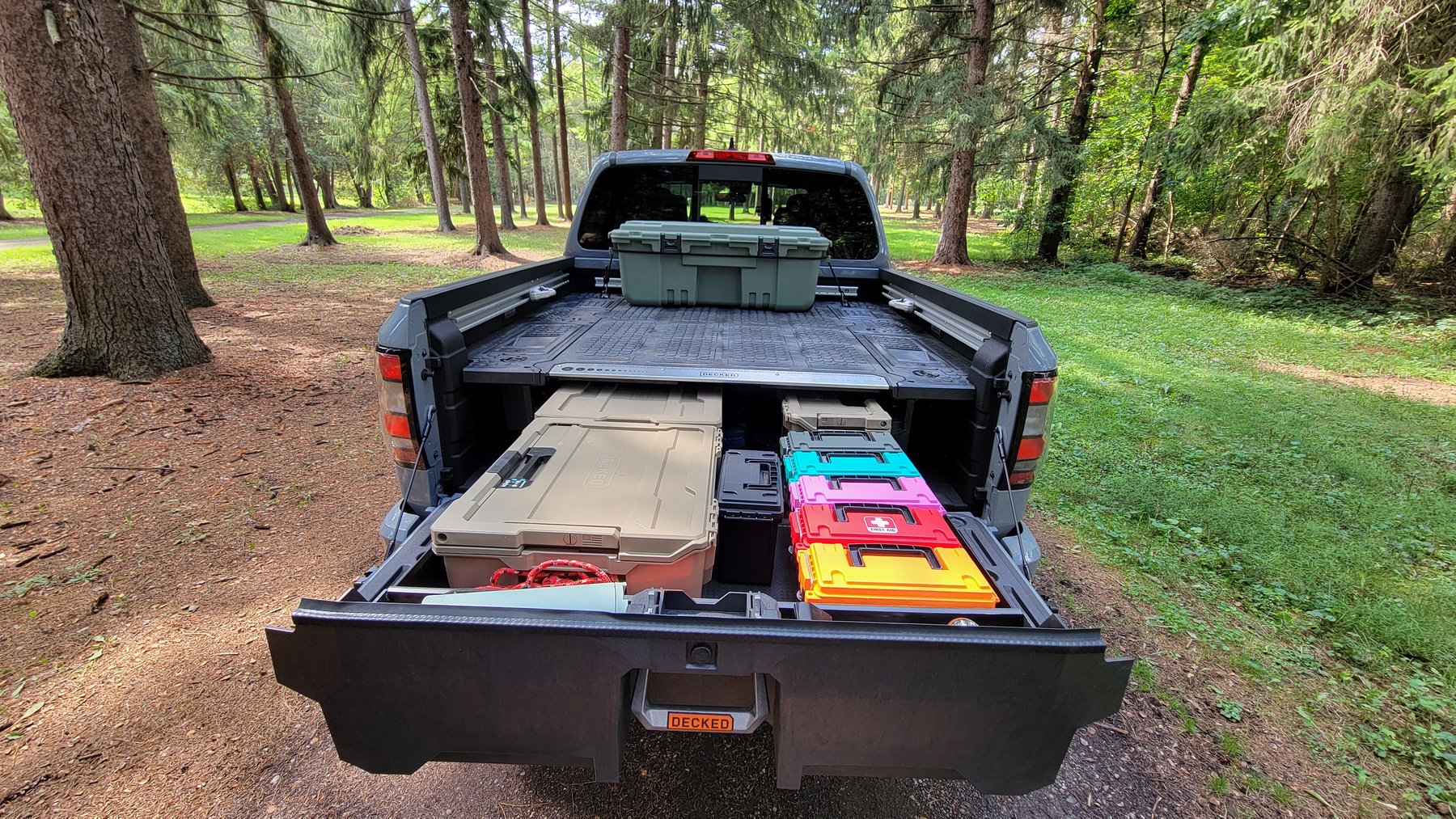
DECKED is 177 lb — the largest single item after the two occupants, and 16 percent of the entire payload. ⚠ Corrected 2026-08-30 from 204 lb, which is the full-size system, not the midsize 5 ft one fitted here. It is an excellent system and it is already bought, so this is not a recommendation to remove it. It is a note that the heaviest thing on the truck is the storage, not the tent, the rack, or the power system, and that fact is invisible in most build discussions. If capacity ever needs to be found in a hurry, this is where the most of it lives.
Two adults at 350 lb is the largest line in the budget and it is not negotiable. It is worth stating plainly because payload conversations routinely forget occupants, and forgetting them here would make every number above look 350 lb friendlier than it is.
4.6 What to do
- ✅ Payload confirmed at 1,100 lb. Done.
- Take the Anker F3000 out of the vehicle plan. 91 lb for nothing, and the electrical dive already reached the same conclusion independently.
- ✅ Tent settled — hardshell, at the owner’s decision. The margin it consumes is what makes items 2 and 4 mandatory rather than optional.
- 🔴 Weigh the truck at a certified scale, loaded as driven, front and rear axle separately. Every est. in the table above is a guess, and there are enough of them that the 300 lb figure could be meaningfully wrong in either direction. This is now the last unmeasured input in the load plan.
- Re-check tyre load ratings against the measured axle weights — the Tires and Wheels dive’s point, and it becomes actionable the moment the scale ticket exists.
- 🔴 Measure tongue weight, trailer level and loaded as towed. It is the only major figure left expressed as a percentage, and the 10-vs-15 percent spread is 66 lb — larger than the entire margin.
References
- The vehicle’s confirmed door-jamb Tire and Loading label: 1,100 lb. 🔴 This does NOT match Nissan’s published maximum for the Crew Cab 4x4 PRO-4X, which is 1,220 lb — the brochure figure is a maximum for the configuration, while the label counts the options actually fitted. ⭐ For payload there is exactly one authority: the label on the vehicle in front of you.
- Nissan USA, 2026 Frontier brochure — maximum payload by trim: Crew Cab 4x4 S 1,330; SV 1,310; PRO-4X 1,220.
- DECKED — drawer system for the 2022+ Frontier 5 ft bed: 177 lb (midsize). The 204 lb figure is the full-size system.
- Topoak Overland — 270° awning, 83 in: 64 lb.
- Anker — SOLIX F3000: 3,072 Wh, just over 91 lb.
- Vehicle Power, this project — why the F3000 is not the vehicle electrical system.
- Rooftop Tent, this project — the softshell/hardshell comparison the payload arithmetic now weights.
- Tires and Wheels, this project — load rating against measured axle weights.
Comments (0)